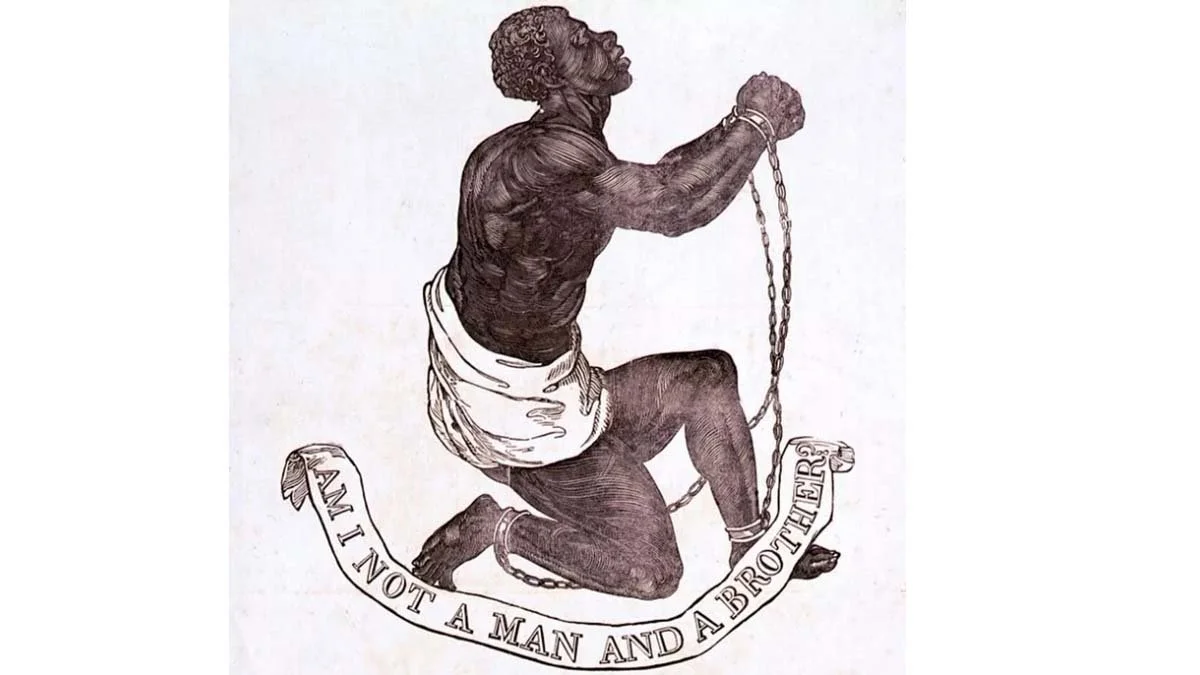

Yes, I Can Use Slavery Analogies to Highlight the Evils of Abortion
/If anything makes abortion activists angry, it’s using slavery analogies to highlight the evils of abortion. What’s even more hilarious is when they are so beyond reason that instead of engaging with the analogy and discussing the purpose of the comparison, to see if the logic even tracks, they will commit the ridicule fallacy. The ridicule fallacy is a logical fallacy when you mock an idea instead of attempting to produce an intelligent response.
Well, I can absolutely make slavery analogies for several reasons.
“What, to the Slave, is the Fourth of July?” is a famous speech given by Frederick Douglass. He opened his speech by talking about the American Revolution. He did deliver his speech on July 3, so it was appropriate. However, he had a very important point to make. While living in 1852, you have the gift of hindsight about what happened in 1775.
To say now that America was right, and England wrong, is exceedingly easy. Everybody can say it; the dastard, not less than the noble brave, can flippantly discant on the tyranny of England towards the American Colonies. It is fashionable to do so; but there was a time when, to pronounce against England, and in favor of the cause of the colonies, tried men's souls. They who did so were accounted in their day, plotters of mischief, agitators and rebels, dangerous men. To side with the right, against the wrong, with the weak against the strong, and with the oppressed against the oppressor! here lies the merit, and the one which, of all others, seems unfashionable in our day.
It’s a wonderful speech in which Douglass challenges his audience because the liberties won by the Founding Fathers didn’t apply to all people. They weren’t fighting courageously enough against their culture of oppression.
We now possess the gift of hindsight, and it seems so obvious that chattel slavery was a hideous institution that should have never been allowed in the US. But that’s an obvious truth in 2025 that would not have been so obvious back in 1852. When slavery is a part of your culture and economics, it’s not so easy to give up. It’s convenient to convince yourself that a black man shouldn’t be looked at as a citizen but as your property. You have to deny their humanity to justify the cruelty. We raise our noses in disgust at that barbaric culture, but back then, it was just good business. There were even slavers who convinced themselves that they were doing it for the good of the slaves.
Abortion doesn’t seem obviously evil to many today. I don’t know why. The mantra used to be “safe, legal, and rare” because it was considered to be a necessary evil. Former President Joe Biden used to say abortion is a “tragedy.” Even staunch abortion defenders will say, “No woman wants to get an abortion,” which isn’t true. They’ll say, “No woman wakes up 24 weeks pregnant and decides to have an abortion willie nilly!” If it were just a glob of tissue, why would it be a big deal? It’s almost as if they acknowledge there’s something heinous about ending a tiny human’s life. It is sickening when women have abortions flippantly, but it doesn’t make it better when women grapple with the decision. It’s a difficult decision because their sons and daughters aren’t meaningless clumps of cells. They are humans with potential, and their mothers are snuffing it out through means of suffocation, starvation, dismemberment, or poisoning.
The reason why so many people take offense to my slavery analogies is that hindsight grants them moral superiority on the issue of slavery, and they’re offended that I would dare to sully their support of child sacrifice in such a way. The reality is that many of these uppity abortion advocates would have likely supported slavery back in the day. They would have been products of the culture, just like they’re the products of today.

Last week, I used an analogy while discussing Uma Thurman’s abortion early in her career, and her daughter’s defense of it. Maya Hawke noted that if she hadn’t had access to “healthcare,” Thurman’s life would have been derailed, and Maya wouldn’t have been born. In response, I told a story about how my dad went to Nigeria and was asked if he was grateful his ancestors were enslaved, since he ended up in the United States as a result. My father was horrified and would have never wished such pain on his ancestors, despite his pride in being an American. My point was that just because a catalyst sets off a certain chain of events, it doesn’t make that particular catalyst good or bad. If a good outcome justifies the catalyst, Maya Hawke and Uma Thurman would have to concede that slavery was good because my dad was born in the US.
Even a story like that prompted visceral reactions from the pro-abortion crowd. No proper refutation. Just rage and insults.
Now, of course, I give more direct comparisons. I explain it like this:
My ancestors were not always considered to be persons, but they were always persons. It was just convenient not to think of them as persons so that they could be denied basic human rights. I have always been a person, but some people would disagree with that. They would say, even though I’ve always been human and alive for as long as I’ve existed, that I was not always a person. They discriminate against me and exclude me from personhood due to my size, level of development, environment, or dependency because it’s convenient to do so. But just like my ancestors, I was always a person entitled to basic human rights.
Is disregarding someone’s rights because they are black the same as disregarding their rights because they don’t, for example, presently possess consciousness? No. But disqualifying a human being from personhood for not presently possessing something inherent to their human nature, that they are on a self-determined path to actualize, doesn’t seem any more intelligent than disqualifying a human based on their physical characteristics.
Are slavery and abortion the same? No, but I do see remarkable similarities in the mentalities required to preserve the legality of both evils. You can only make a bodily autonomy argument for abortion from a one-sided perspective. If you deny that your offspring has a right to life and self-determination, then you can claim it’s bodily autonomy! But a slaveowner is also operating from the one-sided perspective of the oppressor when he uses his bodily autonomy to impose his will on someone else. If you view that distinct human as your property and treat them like an object, it’s easy to disregard them. Bodily autonomy is supposed to be about you making decisions about your life, your body, and your future. It is not about violating someone else’s liberty. It can also be limited in the interest of preserving life. That’s why we have laws on drugs, vaccines, and even punishments for neglecting your children.
While a woman is pregnant, there is a conflict of rights between the mother and child, but we don’t solve rights conflicts with blanket authority to kill.

Every so often, someone will try to flip the script and claim that it’s actually the pro-lifers who are like the slaveowners because they want to “force” the woman to give birth or stay pregnant! Well, I reject the premise that we “force” anything. If your definition of “force” is that we don’t believe it should be legal for mothers to brutally kill their offspring, then I suppose all of the laws in place meant to dissuade violence are force. But do you really believe not being able to tear the limbs off your baby and crush their skull is the equivalent of being whipped by the master’s lash because you didn’t pick cotton fast enough?
When you’re privileged, equality feels like oppression. When I argue that your children should be entitled to the same right to life—the right to not be killed—as their parents, I’m seen as the oppressor. But I’m not oppressing anyone. You’re just spoiled.
The South didn’t take too kindly to the North imposing its morality on them, either.
By the way, many in the North were blissfully unaware of the brutality of slavery. That’s why books like Uncle Tom’s Cabin (which was adapted into a stage play) were so important. Even people who would never personally own a slave were too comfortable with allowing slavery to remain. Some even feared how the liberation of the slaves would impact their daily lives.
Another criticism is that comparing slavery to abortion downplays the brutal reality of slavery. Not every slave suffered a “12 Years a Slave” experience, but it was an evil and ungodly institution that allowed extreme abuse. When Uncle Tom’s Cabin was released, critics thought it was too fictionalized. Author Harriett Beecher Stowe had to make a follow-up book with documented evidence to justify her writings. People didn’t want to believe how awful the slaves were treated.
And when I describe abortion procedures, a lot of people don’t want to hear about that either, or think it’s exaggerated. I’m accused of using “emotional language” for describing D&C or D&E abortions or explaining how the abortion pill works. I’m accused of “intuition pumping” for using words like “baby” or “child,” because they so badly don’t want to think of the preborn as human offspring. The Guardian ran an article that went viral, showing “What Pregnancy looks like before 10 weeks” by showing an aborted fetus, after it had been sucked through a tube, cleaned of blood, and put in a petri dish. Medical students and professionals who support abortion have pushed these images on TikTok, Instagram, and one student tried to push it in an interview with Michael Knowles. She claimed a 9-week fetus is indistinguishable to the naked eye, when it would be about the size of a grape. Abortion advocates cope by calling the offspring a parasite (scientifically inaccurate) and will use other dehumanizing language to ignore the humanity of the human fetus.
Abortion advocates downplay the harm caused by destroying the preborn’s life. I like to ask the question, “Would you have aborted Frederick Douglass to spare him the life of being a slave?”
Instead of answering the question, people will counter with, “You don’t think there were slaves who found ways to abort their children?”
And my reply is, “If they did, that would be sad because they might have aborted a Frederick Douglass.”
The individual has inherent value, but life itself is valuable. When God told Abraham that he would be the father of many nations, he also told him that his descendants would suffer through 400 years of bondage. God also said that all nations would be blessed through his seed (Jesus). Life will bring suffering. That is inevitable. But where there is life, there is hope.
I didn’t want my ancestors to suffer, but if one of my ancestors decided to kill their living child to spare them a life of suffering, they may have also spared them from a life of liberation, love, and family. I also wouldn’t be here. Abortion doesn’t take one life. It ends generations, and we’ve aborted over 63 million individuals since Roe v. Wade in the US. Plus, I have argued abortion has societal harm that extends beyond a woman and her doctor.
Thankfully, Emancipation Day came. There were some bumps along the way for Frederick Douglass and the abolitionists. Dred Scott, for example. But Douglass gave one heck of a speech after the Supreme Court decided the case, and it was one that I read repeatedly after abortion was written into my state constitution. “Slavery lives in this country not because of any paper Constitution, but in the moral blindness of the American people, who persuade themselves that they are safe, though the rights of others may be struck down.” Even though the Supreme Court had delivered a blow to the rights of black men, Douglass had a bright outlook on the future, and he believed the “national conscience” would turn.
Such a decision cannot stand. God will be true though every man be a liar. We can appeal from this hell-black judgment of the Supreme Court, to the court of common sense and common humanity. We can appeal from man to God. If there is no justice on earth, there is yet justice in heaven. You may close your Supreme Court against the black man’s cry for justice, but you cannot, thank God, close against him the ear of a sympathising world, nor shut up the Court of Heaven.
I will continue to make my analogies, if I feel they are appropriate, in the hope that they change hearts and minds. My critics are welcome to debate thoughtfully. If they are unable, they can stay mad.